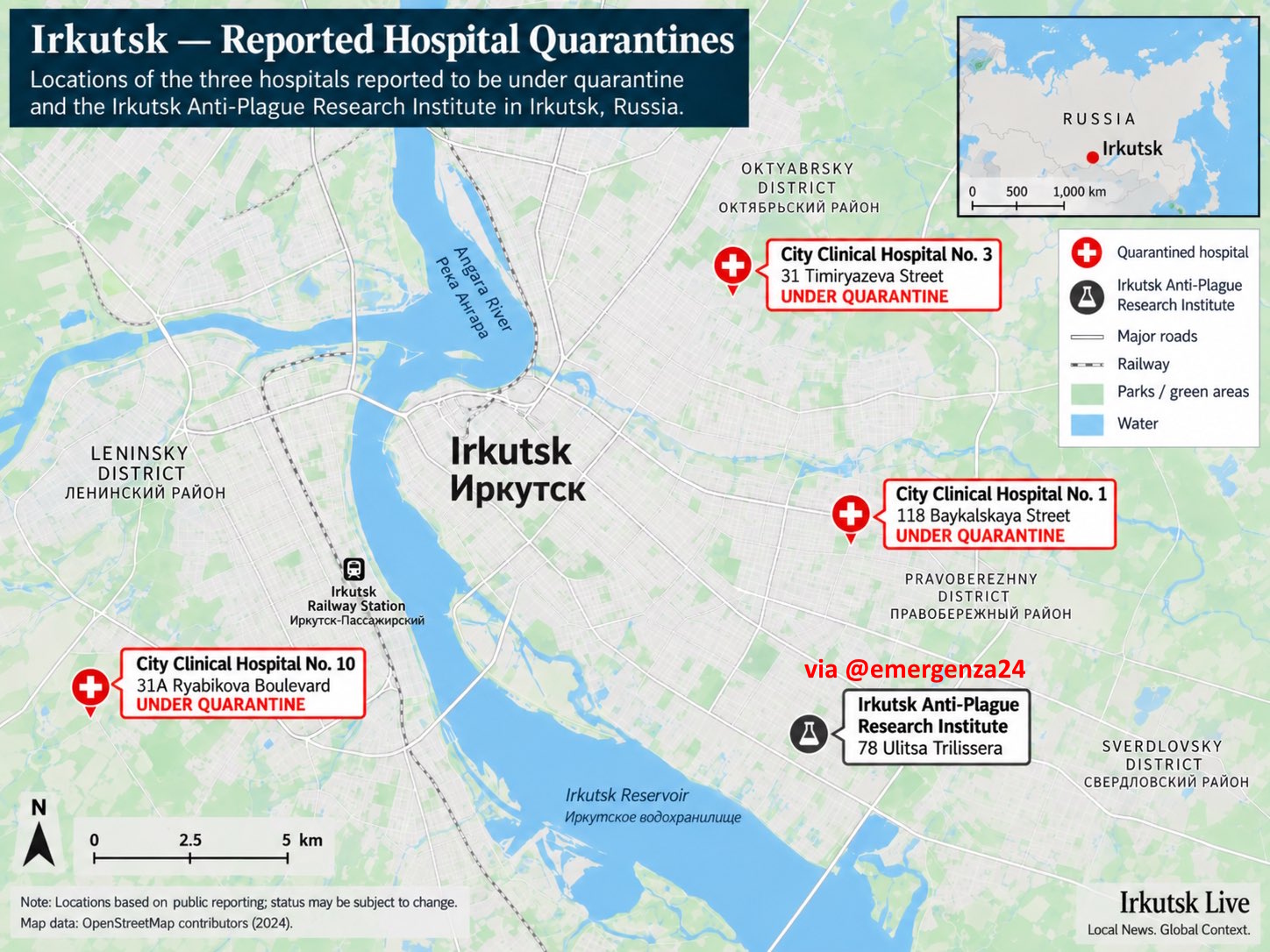
 Questo post argomenta le notizie relative a possibili casi di peste polmonare in Siberia, Russia, a partire da settembre 2026.
Verrà aggiornato fino al termine dell’evento.
Vedi altro caso di peste in Mongolia nel 2020.
Evento concluso il 17.10.2026
CRONOLOGIA INVERSA
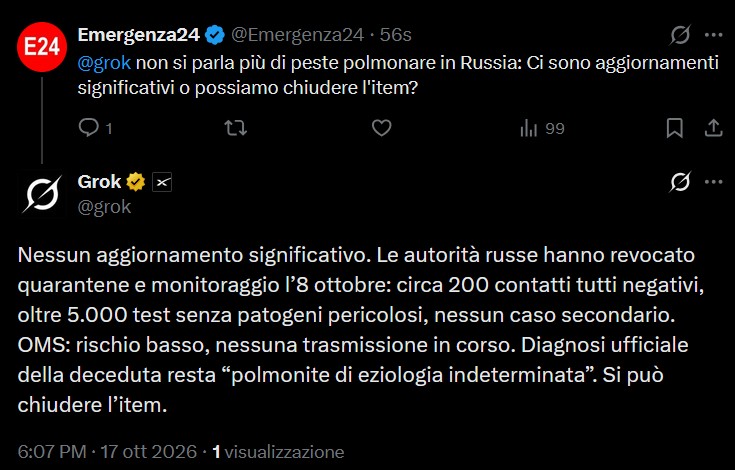
17.10.2026 – 18:00 – Nessuno aggiornamento significativo. Evento concluso
04.10.2026 – 18:00 – CNN – By Tim Lister and Svitlana Vlasova
Researcher at Russian plague laboratory dies of ‘unknown’ infection


Russian authorities are responding to an incident in which a suspected dangerous infection was released as a result of a laboratory accident in Siberia and a researcher died.
The incident occurred at the Anti-Plague Research Institute in Shelekhov, near Irkutsk, according to Russian state media TASS.
It is unclear exactly what was released, according to the state agency that handles infectious disease, Rospotrebnadzor. One person – a laboratory worker – is said to have died in the incident after being diagnosed with a pneumonia of “unknown” origin.
“The sanitary and epidemiological situation in the Irkutsk region, the cities of Irkutsk and Shelekhov is stable,” Rospotrebnadzor said.
Special measures had been carried out “in connection with the case of an employee of the Irkutsk Anti-Plague Institute,” Rospotrebnadzor said, adding that the employee had been diagnosed with “pneumonia of unknown etiology,” or cause.
The head of the neighboring republic of Buryatia, Alexei Tsydenov, said earlier that the employee – a 28-year old woman – died “possibly from the plague.” He also noted that “there are no plague outbreaks” in Buryatia.
The governor of Irkutsk, Igor Kobzev, urged calm on Friday, saying that an extraordinary meeting of the regional anti-epidemic commission was held with Russia’s chief state doctor.
The meeting was in connection with a “suspected case of a particularly dangerous infection affecting a resident of the region,” Kobzev said on Telegram.
An aluminum plant near the laboratory instructed staff to wear masks as a precautionary measure. The director of Irkutsk Aluminum Plant, Artem Fominikh, also urged calm and noted that “there are many rumors and conflicting reports circulating.”
“All identified close contacts are under medical supervision. At present, they show no signs of the disease, and their laboratory test results are negative,” Fominikh said.
Unofficial reports, including by the independent regional news outlet Liudi Baikala, say that nearly 200 people were placed under observation at the hospital in Shelekhov to which the laboratory technician was taken.
Quarantine has also been imposed in at least one of the city’s maternity hospitals, according to Liudi Baikala.
The infection in the Irkutsk region is “most likely not the plague, but even if confirmed, there will be no spread of this disease,” a previous head of Rospotrebnadzor, Gennady Onishchenko, said on Friday.
Onishchenko told the state news agency TASS that the onset of cold weather would likely prevent transmission.
Pneumonic plague is one of three types of plagues that are caused by the bacterium Yersinia pestis. The other two types typically spread from contact with infected fleas, animals or infected tissues. But the pneumonic plague, or lung-based plague, can transfer easily from person to person through respiratory particles.
Patients with pneumonic plague develop fever, headache, weakness and and “a rapidly developing pneumonia with shortness of breath, chest pain, cough, and sometimes bloody or watery mucous,” according to the US Centers for Disease Control and Prevention.
The World Health Organization has noted that plague has a high fatality rate, but is also easily treated with antibiotics and the use of precautions to prevent infections.
04.10.2026 – 16:00 – Grok identifica nel post seguente la prima fonte in X/Twitter (ovvero 02.10.2026 alle 08:20 italiane)

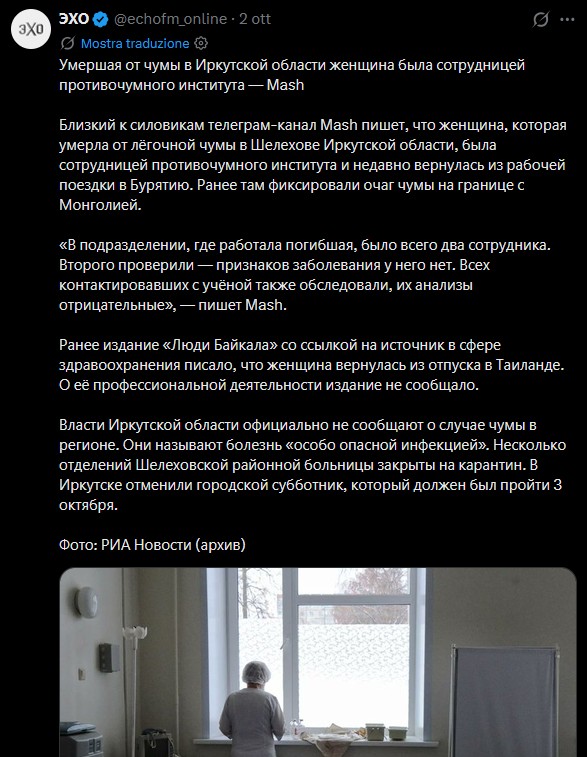
Il testo descrive questo:
Una donna è deceduta per peste nella regione di Irkutsk, era un’impiegata dell’istituto anti epidemico (fonte: Mash).
Il canale Telegram Mash, vicino agli ambienti delle forze dell’ordine, scrive che la donna è morta per peste polmonare a Shelekhov, nella regione di Irkutsk. Era un’impiegata dell’istituto anti epidemico ed era rientrata di recente da un viaggio di lavoro in Buriazia. In precedenza era stato rilevato un focolaio di peste al confine con la Mongolia.
«Nel reparto in cui lavorava la vittima c’erano solo due dipendenti. Il secondo è stato controllato: non presenta segni di malattia. Tutti coloro che sono entrati in contatto con la scienziata sono stati esaminati, e i loro test sono negativi», scrive Mash.
In precedenza, la testata «Ljudi Baikala» citando una fonte nel settore sanitario aveva scritto che la donna era rientrata da una vacanza in Thailandia. La fonte non aveva fornito informazioni sulla sua attività professionale.
Le autorità della regione di Irkutsk non hanno ufficialmente comunicato del caso di peste nella regione. Definiscono la malattia «infezione particolarmente pericolosa». Diversi reparti dell’ospedale distrettuale di Shelekhov sono stati chiusi in quarantena. A Irkutsk è stato annullato un evento cittadino, previsto per il 3 ottobre.
03.10.2026 – 00:00 – Il profilo più attivo sul tema in Twiter/X è “Irkutsk Live” creato a maggio 2026 che recita come mission “Sourced updates on the Irkutsk lab leak. Latest news as it breaks live“.

Il profilo propone anche un sito (irkutsklive.com) di cui non abbiamo informazioni:

Ma grazie a Internet Archive scopriamo che il sito è stato messo online il 03.10.2026.

03.10.2026 – 20:00 – Il sito irkutsklive.com pubblica queste mappe e informazioni.